Housing Repairs
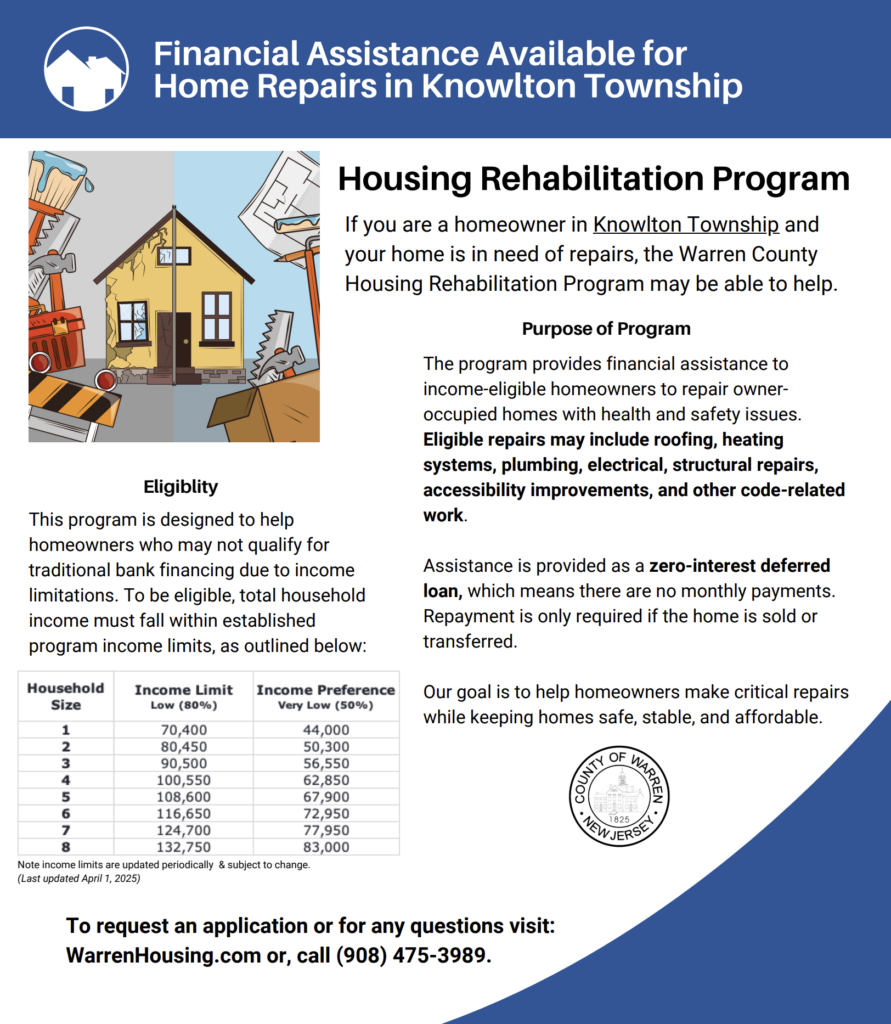
Warren County offers financial assistance to repair owner-occupied homes located in Knowlton with health and safety issues. Eligible applicants must meet certain income-eligibility requirements. Repairs may include:
- Roofing
- Heating; Cooling (if medically necessary)
- Plumbing, Well & Septic
- Electric
- Weatherization
- Structural Damage
- Access into/throughout home
Code Violations that threaten health/safetyAssistance is provided through a zero-interest deferred loan, which means there are no monthly payments. Repayment is only required when the home is sold or transferred. For more information and to apply, fill out the application here.
Please note that all funds used to make eligible home repairs come from the Small Cities Community Development Block Grant program, which provides federal funding to local governments to improve housing for residents who meet income requirements.
Low Income Housing (COAH) Obligations
In 1975 the New Jersey Supreme Court ruled in Mount Laurel 1 (Southern Burlington County N.A.A.C.P. v. Mount Laurel Township) that New Jersey townships must provide opportunities for low income housing. Subsequent lawsuits resulted in the creation of a state agency, the Council on Affordable Housing (COAH), which determines each township’s low income housing obligation and creates mechanisms and rules to guide municipalities in meeting that responsibility.
COAH has had three rounds of rule-making in which the agency set out the number and kind of low income housing each town is obligated to provide. Townships that don’t submit, and show progress on, a plan to meet this obligation are subject to lawsuits that could result in a “builder’s remedy” in which the town’s zoning is overridden so that housing at much higher density than the zoning allows can be built.
Under a builder’s remedy developers can construct not only enough low income housing to meet the township’s obligation but can also build market-rate housing in order to be compensated for providing the less lucrative low income housing. Generally a builder’s remedy allows builders to construct 4 market-rate units for each low-income unit.
Builder’s remedies have been criticized because they can lead to large-scale, inappropriate development. For example, Greenwich Township in Warren County achieved unwelcome notoriety in 1988 when a builder’s remedy forced it to accept a massive development that tripled the size to the township. This led to dramatically higher taxes, and it significantly altered the character of that rural community.
At present the state’s low income housing program is in disarray. A series of successful suits have forced COAH to reconfigure how it determines townships’ low income housing obligations. The governor has declined to appoint COAH administrators, and the program currently has only 3 of its 12 positions filled.
Affordable Housing Midpoint Review
The attached Affordable Housing Midpoint Review is posted in accordance with the Township’s settlement of its affordable housing litigation, In the Matter of the Township of Knowlton, WRN-L-215-15. Any interested party may submit comments to the municipality, with a copy to the Fair Share Housing Center, regarding whether any sites noted in the Midpoint Review no longer present a realistic opportunity and should be replaced. Any interested party may, by motion, request a hearing before the court regarding these issues.